IDENTITY & SELF-EXPERIENCE
How IEMT elicits self-references and distinguishes their location, age and surrounding context.
A reference for trained practitioners. The reported features belong to the person’s experience and are not diagnostic findings.
On this page
Begin with the reference the person uses
Identity work concerns how a person experiences a reference to themselves. The principal references used in IEMT are I, me, self and you. A name, nickname, title or role may also evoke a relevant self-experience.
Each reference is elicited in the context in which it is used. The presence of a pronoun in a sentence does not, on its own, tell the practitioner what the person experiences. The questions establish that report.
The references are not assumed to be interchangeable. A person may describe different locations, ages or contexts for I and me, for example. The distinction is preserved during elicitation and review.
The three elicitation questions
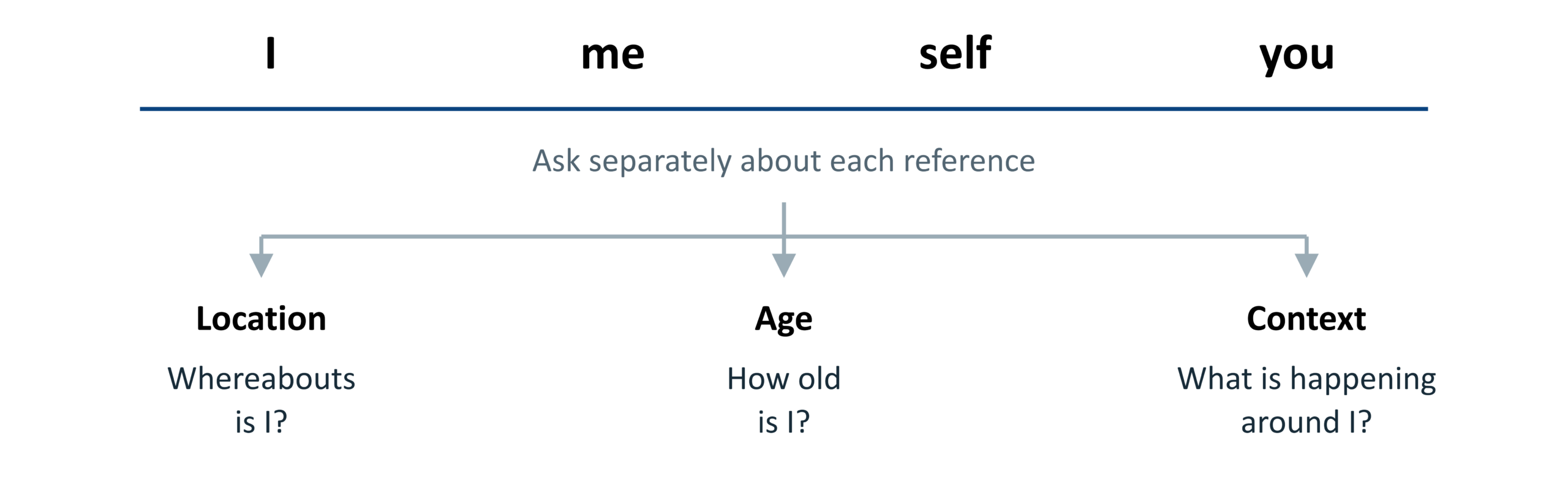
| Dimension | Example using I | What is recorded |
|---|---|---|
| Location | “When you think about I, whereabouts is I?” | The person’s answer and relevant indication or gesture. |
| Age | “And how old is I?” | The age or other answer the person reports. |
| Context | “And what is happening around I?” | The surrounding situation as described. |
Retain the reference in the question
The wording deliberately keeps the reference being examined, even when the grammar sounds unusual. Substituting another self-reference can change what is being elicited.
For me, self or you, the questions retain that word. The practitioner listens to the response rather than correcting it into a more conventional description.
A gesture may be important evidence of where the person locates the reference. Recording that indication preserves the report without requiring an interpretation about why the location was chosen.
Identify what is problematic
The client identifies the aspect of self-experience that is difficult. The location, age or context may be relevant, but an unexpected answer does not automatically make an aspect a target for change.
A reported age younger than chronological age does not itself require correction. The identity procedure does not prescribe that all references should become the person’s present age or occupy a standard location.
Description before judgement
The practitioner first establishes the reported experience, then clarifies what the person finds problematic. The answer is not graded against a predetermined picture of how identity ought to be represented.
The procedure and subsequent review
The selected identity reference is held in attention during the identity eye movement procedure, which uses a figure of eight. This differs from the linear movement forms used in memory work.
Afterwards, the same reference is elicited again. Location, age and surrounding context can then be compared with the earlier account. The client reports whether any difference is useful.
If a feeling is prominent in connection with a name, role or title, that emotional experience may require its own elicitation before returning to the identity reference. A change in the feeling does not automatically establish a change in the self-reference.
Complex self-statements
The statement “I hate myself” combines a relationship of feeling with identity references. The complex pattern separates the active kinaesthetic experience, the passive kinaesthetic experience, the active identity and the passive identity.

Separating components makes it possible to review each on its own terms. These may be addressed over more than one session, with continuing attention to consent, suitability and the client’s response.
Record what has and has not changed
A useful record identifies the reference, the initial report, the aspect selected, the procedure undertaken and the subsequent report. Client description, direct observation and practitioner interpretation remain distinguishable.
These questions describe an IEMT method of eliciting self-experience. They do not constitute a test of personality, a diagnosis or a verified account of how identity is represented in the brain.
Sources and further reading
Source check: 20 October 2026. Consult the linked current policies for operational requirements.


The Association for IEMT Practitioners: www.integraleyemovementtherapy.com
The British Board for IEMT: www.britishboardofiemt.org.uk